What teams are playing?
The Stanford Cardinal and the Oregon State Beavers.
Where is this game being played?
Reser Stadium in Corvallis, Oregon.
What time does the game start and where can I find it on my television?
7:30 PM (PT) on Pac-12 Network.
What is the point spread?
Stanford is favored by four points (-4).
What should I watch for when Stanford has the ball?
Stanford needs to grind this game out with its offense. The Cardinal have struggled to throw the ball anyway but Devin Cajuste their best possession receiver will miss this game with a knee injury. That means Oregon State can put their best corner on Ty Montgomery and provide safety help over the top on every play. Can another play maker step up on third downs? Stanford probably hopes that it won't need to discover an answer to that question. The Cardinal want to run the ball for a few reasons, mostly because the Cardinal want to run because their pass game is hurting without Cajuste and running the ball is their identity anyway.
The other main reason is because Stanford needs to keep the clock moving and limit the number of times Oregon State can touch the ball. This will put a lot of pressure on Stanford's budding young star at left tackle, Andrus Peat. Tonight, Peat will draw the match up of two time (and soon to be three time) All-Pac-12 defensive end Scott Crichton, a devastating defensive player who has made his fame not by sacking the quarterback but by shedding blockers and stopping the run. It is imperative for Peat to use his athleticism to prevent Crichton from crossing him and getting to the middle of the field. Stanford loves to run to the middle of the field and pull their backside guard on trap plays to serve as a lead blocker. That pulling action leaves a brief window when a defender can get into the hole and blow up the play and Crichton has the athleticism and movement skills to disrupt those trap plays. Peat needs to win his match up against Crichton to not only keep Stanford's famed trap play viable but also to prevent a need for double teams on the edge.
Stanford loves to double team blockers in the middle. They like to have one of the guards help the center block a defensive tackle off the ball before moving up to the second level to get to a linebacker. If Peat needs help handling Crichton, that changes the complexion of Stanford's run scheme.
What should I watch for when Oregon State has the ball?
Tonight we will finally find out for certain if Sean Mannion and Brandin Cooks are for real. Mannion and Cooks have been great all year and it has led to Mannion leading the nation in passing yards and passing touchdowns and Cooks being the national leader in every relevant receiving statistic. But, the Beavers haven't faced a good pass defense all season. The stingiest pass defense that Oregon State has faced all year was Utah, a team that currently ranks 76th in the nation pass efficiency defense. Stanford represents is a significant step up in competition for the Beavers. The Cardinal currently ranked 37th in the nation in pass defense but are capable of playing a lot better than that.
Stanford has not displayed the same trademark dominance we are used to seeing from its defense this season but last week they finally showed what makes them so special. The Cardinal ate up UCLA's offensive line and were able to do it without blitzing and that is the key to stopping Oregon State. Mannion thrives against the blitz, he is very good at identifying opposing blitz packages and finding his hot receiver. Blitzing also plays into Oregon State's favorite play, the tunnel screen to Cooks. The few times Mannion has struggled this season has been when teams have been able to get pressure with a four man rush. It hasn't happened often but when Mannion doesn't get time to stand and observe the field without a hot receiver against the blitz, he struggles. Mannion has not had those struggles often because most of the defensive lines he has faced haven't been very adept at rushing the pass but that changes today against Stanford.
The Cardinal need to copy what they did against UCLA last week. They stopped the run and harassed Brett Hundley into bad throws without blitzing. This is where Oregon State has serious problems because the Beavers have not run the ball well at all this year and Stanford is always at its best against one-dimensional teams. Look at Stanford's defensive performances this season against one dimensional passing offenses like Washington State and UCLA juxtaposed to how they played against balanced offenses like Washington and Utah. The Cardinal's defensive performance has been night and day based on how well their opponent can move the ball both by land and by air. Oregon State needs to develop some semblance of running attack tonight because there is nothing the Cardinal love more than predictable offenses.

Athletes in Space is named after ESPN/ABC's Kirk Herbstreit and his favorite saying that has spawned many drinking games. It is the most spectacularly mediocre Pac-12 Football and Men's Basketball blog on the internet and is filled with all the player analysis, game breakdowns, predictions, gambling advice, and news your pretty brain can handle. Owned and operated by Cam Stuerle, a lifelong Oregon fan, non-partisan writer, and an exiled college football lover living in Kelowna, BC, Canada.
Saturday, 26 October 2013

The 2013 Pac-12 Journey Game 64: Nothing personal but Ka'Deem Carey wants to destroy you Colorado
What teams are playing?
The Arizona Wildcats and the Colorado Buffaloes.
Where is this game being played?
Folsom Field in Boulder, Colorado.
What time does the game start and where can I find it on my television?
5:00 PM (PT)/6:00 PM (MT) on Pac-12 Network.
What is the point spread?
Arizona is favored by 13 points (-13)
What should I watch for when Arizona has the ball?
If it seems like Ka'Deem Carey has an extra bounce in his step this week its because of the opponent he is facing. Last year when Colorado faced Arizona, Carey had one of the best rushing performances in Pac-12 history when he exploded for an Arizona record 366 yards and five touchdowns. Less than one full year later, things have not changed much. Carey is once again leading the nation in rushing yards per game and has actually improved his mark from last year by almost 13 yards. The man who had to fill in for Matt Scott at quarterback that day, B.J. Denker, is now the full time starter and is playing well recently after a poor start to the season.
Colorado's defense while better than last year, is still not in any shape to slow down Carey. It's no secret that Colorado is going to give up a lot of yards and a lot of points to Arizona but the key to not getting embarrassed is tackling. Colorado got blown off the ball last year but they compounded that with terrible tackling and that allowed Carey to break five to 10 yard gains into explosive 20+ yard plays. Colorado can't hope to shut Carey down but if they stick to fundamentals they can at least avoid getting embarrassed like last year.
What should I watch for when Colorado has the ball?
Colorado is now starting true freshmen at both quarterback and running back for the first time in school history. Sefo Liufau and Michael Adkins are very talented young football players but it is hard to imagine them playing well enough to pull off an upset against Arizona. Arizona's defense should try to find out if Liufau can answer two questions: How poised and calm is he under pressure and can he go through his progressions effectively? Mike MacIntyre has raved about this kid's calm confidence in the pocket but he didn't have to face much pressure last week against Charleston Southern. Liufau does have an important asset in his disposal in Paul Richardson, one of the best receivers in college football. Arizona needs to double cover him and keep him under wraps and force Liufau to find other receivers. If I'm Arizona defensive coordinator Jeff Casteel, I want to know if Liufau has it in him to look off Richardson and rely on his other receivers or if I can bait him into forcing passes to a covered Richardson.
The Arizona Wildcats and the Colorado Buffaloes.
Where is this game being played?
Folsom Field in Boulder, Colorado.
What time does the game start and where can I find it on my television?
5:00 PM (PT)/6:00 PM (MT) on Pac-12 Network.
What is the point spread?
Arizona is favored by 13 points (-13)
What should I watch for when Arizona has the ball?
If it seems like Ka'Deem Carey has an extra bounce in his step this week its because of the opponent he is facing. Last year when Colorado faced Arizona, Carey had one of the best rushing performances in Pac-12 history when he exploded for an Arizona record 366 yards and five touchdowns. Less than one full year later, things have not changed much. Carey is once again leading the nation in rushing yards per game and has actually improved his mark from last year by almost 13 yards. The man who had to fill in for Matt Scott at quarterback that day, B.J. Denker, is now the full time starter and is playing well recently after a poor start to the season.
Colorado's defense while better than last year, is still not in any shape to slow down Carey. It's no secret that Colorado is going to give up a lot of yards and a lot of points to Arizona but the key to not getting embarrassed is tackling. Colorado got blown off the ball last year but they compounded that with terrible tackling and that allowed Carey to break five to 10 yard gains into explosive 20+ yard plays. Colorado can't hope to shut Carey down but if they stick to fundamentals they can at least avoid getting embarrassed like last year.
What should I watch for when Colorado has the ball?
Colorado is now starting true freshmen at both quarterback and running back for the first time in school history. Sefo Liufau and Michael Adkins are very talented young football players but it is hard to imagine them playing well enough to pull off an upset against Arizona. Arizona's defense should try to find out if Liufau can answer two questions: How poised and calm is he under pressure and can he go through his progressions effectively? Mike MacIntyre has raved about this kid's calm confidence in the pocket but he didn't have to face much pressure last week against Charleston Southern. Liufau does have an important asset in his disposal in Paul Richardson, one of the best receivers in college football. Arizona needs to double cover him and keep him under wraps and force Liufau to find other receivers. If I'm Arizona defensive coordinator Jeff Casteel, I want to know if Liufau has it in him to look off Richardson and rely on his other receivers or if I can bait him into forcing passes to a covered Richardson.
Friday, 25 October 2013
The 2013 Pac-12 Journey Game 63: UCLA dares to oppose Oregon's march of destruction
What teams are playing?
The UCLA Bruins and the Oregon Ducks.
Where is this game being played?
Autzen Stadium in Eugene, Oregon.
What time does this game start and where can I find it on my television?
4:00 PM (PT) on ESPN.
What is the point spread?
Oregon is favored by 23 and a half points (-23.5)
What should I watch for when UCLA has the ball?
Can the Bruins even get a competent performance from its offensive line? Through injuries and poor performance, the Bruins have turned to three freshmen including two true freshmen on the offensive line and it led to disaster against Stanford last week. The Bruins were out-manned all day and could not have run the ball even if they did have Jordan James at running back. Brett Hundley is a great football player but he is still a little raw as a pocket passer and does not throw on the run nearly as well as you would probably think. This was on display last week as the pocket collapsed around Hundley and while he did manage to extend plays, he was not able to throw accurately on the run and that left the Bruins shut out in the first half on their way to one of their worst offensive performances in school history.
In theory, UCLA should be better this week. Freshmen, especially talented freshmen like right guard Alex Redmond and right tackle Scott Quessenberry tend to get better quickly with each start and you would think that UCLA's line could not play any worse than it did last week. Oregon does have a very big and athletic defensive line that has been disruptive this season but they are not quite as imposing as Stanford's unchained animals. But then you remember where this game is being played, perhaps the last place in the country where you want to travel with a young offensive line. Autzen Stadium has built a reputation for devouring inexperienced players. With a night game and ESPN's College Gameday in town, the Oregon crowd should be as raucous as ever and they will be especially hard on a player like Redmond who was once a verbal commit to the Ducks.
UCLA needs to speed up the process in the back field. Hundley needs to throw the ball quickly and on time; receive the snap, plant his foot, and throw. If Hundley plants his back foot and tries to scan the field, he will get consumed by pressure. UCLA also needs to rediscover its rushing attack even if James misses a third straight contest. Run blocking is a heck of a lot easier to do than pass blocking and it is certainly easier to communicate amongst a young offensive line. In run blocking, the offensive line is firing out and dictating the play to the defensive front seven, but on pass plays the line has to sit back and allow the defense to dictate the play to them. This has been especially problematic for UCLA even before injuries started to mount. With a sophomore first year starter at center, the Bruins have had issues identifying blitz packages and adjusting protections all season. Oregon loves to play a very aggressive and attacking style and must be excited to see the turmoil on UCLA's O-line. The Ducks use a lot of complex blitz schemes especially with their "radar" defense that involves no one putting their hand on the ground which confuses the offensive line because they can't possibly decipher who is blitzing and who is dropping into coverage.
If UCLA can raise its game up front and Hundley can show more poise under pressure than he did last week then UCLA has a chance. If Hundley is slow to get the ball out of his hands and if Paul Perkins or Malcolm Jones can't finally step up and pick up the slack from James, then UCLA will get consumed.
What should I watch for when Oregon has the ball?
The most fascinating chess match within this game is how Oregon will deal with Anthony Barr. The nature of Oregon's offense is ideal for neutralizing a great player in the front seven. The Ducks always love to run zone read but will be especially active with their bread and butter play on Saturday in an effort to handle Barr. It sounds counter intuitive but the best way to block an elite defensive lineman or linebacker is to not block him at all. The Ducks will leave Barr unblocked and run their offense based on what he does. If he attacks down hill toward the mesh point between the quarterback and running back, then Marcus Mariota will pull the ball out of the running back's stomach and run. De'Anthony Thomas will return after missing the last four games with ankle injury so Oregon should have no trouble running away from Barr. If Barr sits back and waits for the play to develop, Mariota will let his running back keep the ball and run away from him.
Analysts and talking heads talk at great length about stopping the Oregon offense and they wonder out loud what scheme exists to stop the Ducks. The truth is, there is no specific scheme or system that is built to stop a team like Oregon. The equation for stopping the Ducks is the same now as it always has been and it is brutally simple, defeat blocks. Barr or whoever is designated as the read man is unblocked and made irrelevant in the play but if anyone up front can shed a block and get into the back field, the play is dead every time. The rest of UCLA's front seven all must have a career day if UCLA is to have any shot at beating the Ducks.
UCLA can win on running downs but they will only have won half the battle because Oregon has developed into an elite passing offense this season as well. As great as Oregon has been on offense since 2007, the Ducks have always been deceptively one dimensional with marginally talented quarterbacks like Jeremiah Masoli and Darron Thomas. Mariota has flipped that equation and has become an elite pocket passer who is also lethal on the ground. In past years, defenses could get off the field against the Ducks simply by forcing third and long but not this year. Teams can't easily force incomplete passes with Mariota playing at such a high level and with Josh Huff and Bralon Addison emerging as the best tandem of wide receivers Oregon has had in over a decade. This is where Barr can make his impact. He needs to beat future All-Pac-12 left tackle Tyler Johnstone and pressure Mariota into bad throws because as talented as the UCLA secondary is, they won't be able to hold up for long against Oregon's receivers.
Johnstone has to have a great game protecting Mariota from Barr. Right tackle Jake Fisher is banged up and unlikely to play and whether it's Fisher or true freshman Cameron Hunt at right tackle, the Ducks will have to dedicate their tight ends and running backs to helping their right tackle block Keenan Graham who has five sacks this year and has been a perfect compliment to Barr. Normally teams assign as much help as they can to Barr but that won't be possible for the Ducks on Saturday. Johnstone needs to play his best game yet or else UCLA could slow down Oregon's offense.
The UCLA Bruins and the Oregon Ducks.
Where is this game being played?
Autzen Stadium in Eugene, Oregon.
What time does this game start and where can I find it on my television?
4:00 PM (PT) on ESPN.
What is the point spread?
Oregon is favored by 23 and a half points (-23.5)
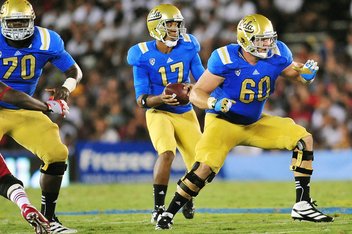
What should I watch for when UCLA has the ball?
 |
| Gary A. Vasquez/US Presswire |
Can the Bruins even get a competent performance from its offensive line? Through injuries and poor performance, the Bruins have turned to three freshmen including two true freshmen on the offensive line and it led to disaster against Stanford last week. The Bruins were out-manned all day and could not have run the ball even if they did have Jordan James at running back. Brett Hundley is a great football player but he is still a little raw as a pocket passer and does not throw on the run nearly as well as you would probably think. This was on display last week as the pocket collapsed around Hundley and while he did manage to extend plays, he was not able to throw accurately on the run and that left the Bruins shut out in the first half on their way to one of their worst offensive performances in school history.
In theory, UCLA should be better this week. Freshmen, especially talented freshmen like right guard Alex Redmond and right tackle Scott Quessenberry tend to get better quickly with each start and you would think that UCLA's line could not play any worse than it did last week. Oregon does have a very big and athletic defensive line that has been disruptive this season but they are not quite as imposing as Stanford's unchained animals. But then you remember where this game is being played, perhaps the last place in the country where you want to travel with a young offensive line. Autzen Stadium has built a reputation for devouring inexperienced players. With a night game and ESPN's College Gameday in town, the Oregon crowd should be as raucous as ever and they will be especially hard on a player like Redmond who was once a verbal commit to the Ducks.
UCLA needs to speed up the process in the back field. Hundley needs to throw the ball quickly and on time; receive the snap, plant his foot, and throw. If Hundley plants his back foot and tries to scan the field, he will get consumed by pressure. UCLA also needs to rediscover its rushing attack even if James misses a third straight contest. Run blocking is a heck of a lot easier to do than pass blocking and it is certainly easier to communicate amongst a young offensive line. In run blocking, the offensive line is firing out and dictating the play to the defensive front seven, but on pass plays the line has to sit back and allow the defense to dictate the play to them. This has been especially problematic for UCLA even before injuries started to mount. With a sophomore first year starter at center, the Bruins have had issues identifying blitz packages and adjusting protections all season. Oregon loves to play a very aggressive and attacking style and must be excited to see the turmoil on UCLA's O-line. The Ducks use a lot of complex blitz schemes especially with their "radar" defense that involves no one putting their hand on the ground which confuses the offensive line because they can't possibly decipher who is blitzing and who is dropping into coverage.
If UCLA can raise its game up front and Hundley can show more poise under pressure than he did last week then UCLA has a chance. If Hundley is slow to get the ball out of his hands and if Paul Perkins or Malcolm Jones can't finally step up and pick up the slack from James, then UCLA will get consumed.
What should I watch for when Oregon has the ball?
 |
| Andrew Shurtleff/AP Photo |
The most fascinating chess match within this game is how Oregon will deal with Anthony Barr. The nature of Oregon's offense is ideal for neutralizing a great player in the front seven. The Ducks always love to run zone read but will be especially active with their bread and butter play on Saturday in an effort to handle Barr. It sounds counter intuitive but the best way to block an elite defensive lineman or linebacker is to not block him at all. The Ducks will leave Barr unblocked and run their offense based on what he does. If he attacks down hill toward the mesh point between the quarterback and running back, then Marcus Mariota will pull the ball out of the running back's stomach and run. De'Anthony Thomas will return after missing the last four games with ankle injury so Oregon should have no trouble running away from Barr. If Barr sits back and waits for the play to develop, Mariota will let his running back keep the ball and run away from him.
Analysts and talking heads talk at great length about stopping the Oregon offense and they wonder out loud what scheme exists to stop the Ducks. The truth is, there is no specific scheme or system that is built to stop a team like Oregon. The equation for stopping the Ducks is the same now as it always has been and it is brutally simple, defeat blocks. Barr or whoever is designated as the read man is unblocked and made irrelevant in the play but if anyone up front can shed a block and get into the back field, the play is dead every time. The rest of UCLA's front seven all must have a career day if UCLA is to have any shot at beating the Ducks.
UCLA can win on running downs but they will only have won half the battle because Oregon has developed into an elite passing offense this season as well. As great as Oregon has been on offense since 2007, the Ducks have always been deceptively one dimensional with marginally talented quarterbacks like Jeremiah Masoli and Darron Thomas. Mariota has flipped that equation and has become an elite pocket passer who is also lethal on the ground. In past years, defenses could get off the field against the Ducks simply by forcing third and long but not this year. Teams can't easily force incomplete passes with Mariota playing at such a high level and with Josh Huff and Bralon Addison emerging as the best tandem of wide receivers Oregon has had in over a decade. This is where Barr can make his impact. He needs to beat future All-Pac-12 left tackle Tyler Johnstone and pressure Mariota into bad throws because as talented as the UCLA secondary is, they won't be able to hold up for long against Oregon's receivers.
Johnstone has to have a great game protecting Mariota from Barr. Right tackle Jake Fisher is banged up and unlikely to play and whether it's Fisher or true freshman Cameron Hunt at right tackle, the Ducks will have to dedicate their tight ends and running backs to helping their right tackle block Keenan Graham who has five sacks this year and has been a perfect compliment to Barr. Normally teams assign as much help as they can to Barr but that won't be possible for the Ducks on Saturday. Johnstone needs to play his best game yet or else UCLA could slow down Oregon's offense.
The 2013 Pac-12 Journey Game 62: Can USC field a full team?
What teams are playing?
The Utah Utes and the USC Trojans.
Where is this game being played?
The Los Angeles Memorial Coliseum in Los Angeles, California.
What time does the game start and where can I find it on my television?
1:00 PM (PT)/2:00 PM (MT) on Pac-12 Network.
What is the point spread?
USC is favored by six points (-6)
What should I watch for when Utah has the ball?
The biggest factor in this game for either team is the health of Utah quarterback Travis Wilson. Wilson banged up his throwing hand last week and sustained an injury to his index finger. He was removed from the game after completing only three of nine passes and throwing a pair of interceptions. Wilson has been adamant all week that he will play despite his injury but we won't know until game time if that is a good thing. Is Wilson's finger in good enough shape to throw a tight spiral and remain accurate? If Wilson can't throw effectively how much rope will Kyle Whittingham give him before pulling him?
The biggest key will be whether Utah can minimize Wilson's impact on the game by running the ball effectively. The biggest reason Utah struggled last week wasn't because Wilson was knocked from the game and Adam Schultz completed only 13/24 passes in his stead. Utah failed on offense last week because the Utes could not run the ball and ended up putting the game on the shoulders of an inexperienced backup QB. Last week Kelvin York and Bubba Poole averaged less than four yards per carry and Lucky Radley had 37 of his 56 yards on one carry. Utah should be fine whether Wilson plays or not if they can minimize their need for big pass plays and get production on the ground.
Obviously, that means the key for USC's defense will be simple fundamentals. Can USC wrap up and tackle Utah's running backs and can the Trojans plug gaps avoid letting Utah blow open big running lanes? Once USC does wrap up and tackle, they need to get pressure on Wilson. No matter what health situation Wilson is in, he is sure to be at least a little short on confidence, doubting whether he can throw effectively. USC needs to pressure him and hurt his confidence as much as they can. If Wilson can build a rhythm with some early completions and allow his adrenaline to dull his pain, then USC will get shredded.
What should I watch for when USC has the ball?
At this point what do the Trojans have left? This goes for the Trojans defense as well but the offense in particular has been decimated by injuries this year. Star wide receiver Marqise Lee aggravated his knee injury against Notre Dame and the Trojans top two tight ends Randall Telfer and Xavier Grimble have been ruled out for at least the Utah game while highly productive running back Justin Davis has been pronounced out for the rest of the season. The Trojans only had 53 players available to play against Notre Dame and lost the four players above as well as starting corner back Anthony Brown on defense. That leaves USC with no more than 48 of the players available last week to play on Saturday and it necessitates that USC will have to start emptying its bench and play walk-ons during meaning snaps. With Lee out and Nelson Agholor slowed by a rib injury (one that he will play through), the Trojans will have to play at least two and possibly as many as four walk-on wide receivers.
USC needs to do the exact same thing Utah must, run the ball. After Lee went down and USC's passing game devolved into a farce USC tried to shift to a run first game plan but couldn't consistently clear running lines against Notre Dame's very stout defensive line. USC fell behind 14-10 in the second quarter and began nine drives with a chance to retake the lead but didn't score any points over the course of the final 32 minutes of the game. USC was inconsistent on the ground and that left USC in a lot of third and long situations with a mediocre QB throwing to non-scholarship receivers.
This is all welcome news to Utah, a team that absolutely adores one dimensional offenses. What do Utah's two biggest wins (at BYU and Stanford) have in common? They were both against offenses that relied heavily on the run but Utah managed to neutralize both running threats and put the game on the arms of Taysom Hill and Kevin Hogan. Hill and Hogan weren't able to make big throws in obvious pass situations to move the ball on Utah and you're kidding yourself if you think Cody Kessler can succeed where those guys failed. The hope for USC is that Utah's run defense has not been singularly dominant as evidenced by what Arizona did last week. If The Trojans can copy Arizona's game plan and run effectively and compliment that with efficient and mistake free passing then the Trojans will have a great chance to win. If Silas Redd can't produce on the ground, then USC will be in a really tight spot.
The Utah Utes and the USC Trojans.
Where is this game being played?
The Los Angeles Memorial Coliseum in Los Angeles, California.
What time does the game start and where can I find it on my television?
1:00 PM (PT)/2:00 PM (MT) on Pac-12 Network.
What is the point spread?
USC is favored by six points (-6)
What should I watch for when Utah has the ball?
 |
| Rick Bowmer/AP |
The biggest factor in this game for either team is the health of Utah quarterback Travis Wilson. Wilson banged up his throwing hand last week and sustained an injury to his index finger. He was removed from the game after completing only three of nine passes and throwing a pair of interceptions. Wilson has been adamant all week that he will play despite his injury but we won't know until game time if that is a good thing. Is Wilson's finger in good enough shape to throw a tight spiral and remain accurate? If Wilson can't throw effectively how much rope will Kyle Whittingham give him before pulling him?
The biggest key will be whether Utah can minimize Wilson's impact on the game by running the ball effectively. The biggest reason Utah struggled last week wasn't because Wilson was knocked from the game and Adam Schultz completed only 13/24 passes in his stead. Utah failed on offense last week because the Utes could not run the ball and ended up putting the game on the shoulders of an inexperienced backup QB. Last week Kelvin York and Bubba Poole averaged less than four yards per carry and Lucky Radley had 37 of his 56 yards on one carry. Utah should be fine whether Wilson plays or not if they can minimize their need for big pass plays and get production on the ground.
Obviously, that means the key for USC's defense will be simple fundamentals. Can USC wrap up and tackle Utah's running backs and can the Trojans plug gaps avoid letting Utah blow open big running lanes? Once USC does wrap up and tackle, they need to get pressure on Wilson. No matter what health situation Wilson is in, he is sure to be at least a little short on confidence, doubting whether he can throw effectively. USC needs to pressure him and hurt his confidence as much as they can. If Wilson can build a rhythm with some early completions and allow his adrenaline to dull his pain, then USC will get shredded.
What should I watch for when USC has the ball?
 |
| Jonathan Daniel/Getty Images |
At this point what do the Trojans have left? This goes for the Trojans defense as well but the offense in particular has been decimated by injuries this year. Star wide receiver Marqise Lee aggravated his knee injury against Notre Dame and the Trojans top two tight ends Randall Telfer and Xavier Grimble have been ruled out for at least the Utah game while highly productive running back Justin Davis has been pronounced out for the rest of the season. The Trojans only had 53 players available to play against Notre Dame and lost the four players above as well as starting corner back Anthony Brown on defense. That leaves USC with no more than 48 of the players available last week to play on Saturday and it necessitates that USC will have to start emptying its bench and play walk-ons during meaning snaps. With Lee out and Nelson Agholor slowed by a rib injury (one that he will play through), the Trojans will have to play at least two and possibly as many as four walk-on wide receivers.
USC needs to do the exact same thing Utah must, run the ball. After Lee went down and USC's passing game devolved into a farce USC tried to shift to a run first game plan but couldn't consistently clear running lines against Notre Dame's very stout defensive line. USC fell behind 14-10 in the second quarter and began nine drives with a chance to retake the lead but didn't score any points over the course of the final 32 minutes of the game. USC was inconsistent on the ground and that left USC in a lot of third and long situations with a mediocre QB throwing to non-scholarship receivers.
This is all welcome news to Utah, a team that absolutely adores one dimensional offenses. What do Utah's two biggest wins (at BYU and Stanford) have in common? They were both against offenses that relied heavily on the run but Utah managed to neutralize both running threats and put the game on the arms of Taysom Hill and Kevin Hogan. Hill and Hogan weren't able to make big throws in obvious pass situations to move the ball on Utah and you're kidding yourself if you think Cody Kessler can succeed where those guys failed. The hope for USC is that Utah's run defense has not been singularly dominant as evidenced by what Arizona did last week. If The Trojans can copy Arizona's game plan and run effectively and compliment that with efficient and mistake free passing then the Trojans will have a great chance to win. If Silas Redd can't produce on the ground, then USC will be in a really tight spot.
Thursday, 24 October 2013
2013 Pac-12 Power Rankings: Week Eight
1. Oregon (Overall: 7-0, Conference: 4-0, Last Week: 1)
Oregon obliterated Washington State by a deceptively close margin of 62-38. It was deceptive because Washington State's first two scores came off uncharacteristic fumbles by Marcus Mariota and the last two came in garbage time against Oregon's scout team late in the 4th. After a few weeks of looking like a pass first team the Ducks got back to being a dominating ground attack as both Byron Marshall and Thomas Tyner had career games. The Ducks have both a positive and negative outlook on the injury side. De'Anthony Thomas will return this Saturday after missing the last four games with an ankle injury but perhaps more importantly is the status of right tackle Jake Fisher. Fisher surprisingly missed the Wazzou game with an undisclosed injury and true freshman Cameron Hunt started in his place and really struggled. If Hunt has to play again we'll have to see if he can play better and rise to the challenge of UCLA's pass rush.
2. Stanford (6-1, 4-1, LW: 4)
Stanford rediscovered its identity against UCLA by establishing a great power running game and absolutely suffocating UCLA's offense with an unblockable front seven. The real test will be whether Stanford can maintain its identity and grind a game out on the road against Oregon State.
3. Oregon State (6-1, 4-0, LW: 3)
While the Ducks get all the attention, Oregon State has quietly combined with the Ducks to make the state of Oregon undefeated in conference play. The Beavers have righted the ship following a disastrous opening weekend loss to Eastern Washington and have done it with the nation's most productive passing game and an opportunistic (albeit leaky) defense. It was somewhat predictable that OSU would redefine its season against a weak schedule but in the coming weeks we will see if Oregon State is a good team after all. The Beavers first four conference opponents are a combined 12-16 but the next five are currently 26-8.
4. UCLA (5-1, 2-1, LW: 2)
UCLA's offensive line has totally fallen apart and that has put UCLA at risk of watching its entire season crumble. The Bruins have already been forced to insert true freshmen Alex Redmond and Scott Quessenberry due to injuries and may be forced to play a third freshman going forward. Left tackle Simon Goines went down against Stanford and is highly questionable to play against Oregon on Saturday. His replacement Conor McDermott as well as Redmond and Quessenberry played very poorly against Stanford. Frankly the Bruins were probably lucky just to get to 10 points. The Bruins' reshuffled line as well as an injury to productive running back Jordan James has removed UCLA's ability to run the ball as well as the play action pass which are both crucial to UCLA's game plan. If the Bruins can't raise their level of play up front, the Bruins could fall into a tailspin.
5. Arizona State (5-2, 3-1, LW: 7)
Every time you pronounce the Sun Devils overrated and locked into the middle tier they go out and score a big win and blow out a previously good team. The Sun Devils embarrassed Washington along both lines by out rushing them 305 to -5. Yes, that's -5 as in the Huskies failed to produce positive yardage on the ground. We know the Sun Devils offense is great but all year we had been expecting ASU's defensive line to come up big and were routinely left disappointed. The Devils' line finally showed up last week by corralling the now former Pac-12 leading rusher Bishop Sankey and putting relentless pressure on Keith Price.
6. Arizona (4-2, 2-1, LW: 10)
Maybe B.J. Denker's performance against USC was not a fluke. Denker was far from spectacular but he was mistake free and really efficient on third down. That made him the perfect compliment to the new leading rusher in the Pac-12, Ka'Deem Carey, who run over Utah to the tune of 236 yards. The Wildcats defense also got back on track by knocking around Utah's great QB Travis Wilson (more on him in a second) and holding both Bubba Poole and Kelvin York to under four yards per carry.
7. Utah (4-3, 1-3, LW: 5)
Utah played a sloppy game and suffered an unfortunate letdown against Arizona after its huge win over Stanford and now find themselves back in a desperate search for six wins. Greatly hampering that run for a bowl game is the health of QB Travis Wilson who sustained an injury to his right index finger. He tried to play through it against Arizona but went 3/9 with two interceptions before the Utah training staff put their foot down and made him sit on the bench. Wilson said he will "suck it up and play" against USC and that sounds great right now but that goes out the window if he can't throw.
8. Washington (4-3, 1-3, LW: 6)
Washington reopened a beautifully renovated stadium, added some new uniform combinations, and overhauled its offense. The Huskies tried as hard as they can to be the Ducks and for five weeks they fooled a lot of people into thinking they were on that level. You can dress up Steve Sarkisian and his Washington program to look like Oregon for awhile but eventually the facade wears off and the Huskies get exposed for being the same team they always have been. Washington put forth a pathetic effort against Arizona State and were humiliated in every phase of the game. The Huskies are now on a three game losing streak and with road games against Oregon State and UCLA still to come, the Huskies sure look like a lock to be the same mediocre seven win team they have been the last four years.
9. Washington State (4-4, 2-3, LW: 8)
Washington State's fight and all around effort against Oregon was impressive especially compared to their defeatist mentality against Stanford and their fourth quarter meltdown against Oregon State. That said, the Cougars were pushed around in the run game by a short handed Oregon offensive line but more importantly, the Cougars have reached a critical mass with their quarterback situation. Connor Halliday played poorly again by throwing four interceptions and although he passed for over 500 yards and four touchdowns, he needed an NCAA record 89 pass attemtps to do it. The Cougars were once a feel good story and looked to be well on track to qualify for a bowl game but they won't win another game if they don't get improved quarterback play and start making a stand on run defense.
10. USC (4-3, 1-2, LW: 9)
Forget USC's pitiful offensive performance against Notre Dame. If you watched a second of that horror show I'm sure you are as eager as I am to forget it ever happened. The far more important thing for USC right now is the team's health. The Trojans could only play 53 players against Notre Dame and this week pronounced cornerback Anthony Brown and tight ends Randall Telfer and Xavier grimble out for the Utah game. That puts USC at 50 total scholarship and walk-on players (the normal scholarship limit is 85) available this week and the status of top receivers Marqise Lee and Nelson Agholor is in doubt after both left the Notre Dame game in considerable pain. USC was able to get excited and play well for one game under Ed Orgeron but the weight of the team's injuries sure looks like it has crippled them.
11. Colorado (3-3, 0-3, LW: 11)
Okay so maybe Colorado's roster is not quite akin to an FCS team. The Buffs allowed the game to become interesting in the second quarter but, they ultimately pulled away with a sound 43-10 victory over Charleston Southern. Colorado still has no hope of competing with any team in the conference other than California (and dare I say, USC), but it was nice to see the young Buffs play well for a change.
12. California (1-6, 0-4, LW: 12)

The Award Tracker:
Pac-12 Offensive Player of the Year:
1. QB Marcus Mariota, So., Oregon (LW: 1)
Marcus Mariota is no longer turnover free after fumbling twice against Washington State but he is still without an interception and is the only quarterback with at least five starts this season that has not been picked off. Mariota now has 28 total touchdowns and after struggling with his accuracy early in the season, he has completed better than 71% of his throws in consecutive games.
2. WR Brandin Cooks, Jr., Oregon State (LW: 3)
Yes Oregon State's secondary is an abomination but Cooks' performance of 13 catches for 232 yards and a touchdown was amazing regardless. The skill of Cal's DBs was obviously suffering but Cooks was being double covered on every play and still could not be contained.
3. RB Ka'Deem Carey, Jr., Arizona (LW: NR)
Bishop Sankey was leading the Pac-12 in rushing but his dud of a performance (13 carries for 22 yards) dropped him from third to eighth nationally while Carey exploded against a very good Utah defensive front and now leads the nation with 161 rushing yards per game. Carey has not been held under 128 yards this season and has scored at least once in every game except for one.
Honorable Mentions:
QB Sean Mannion, Jr., Oregon State
QB Brett Hundley, So., UCLA
RB Bishop Sankey, Jr., Washington
Pac-12 Defensive Player of the Year:
1. LB Anthony Barr, Sr., UCLA (LW: 1)
Barr was great again against Stanford recording eight total tackles including one for a loss (a rather impressive one at that) and made numerous other stat-less plays by controlling the edge and preventing Stanford's ball carrier from breaking outside for big gains.
2. DE Scott Crichton, Jr., Oregon State (LW: 2)
After Washington State spent the entire game trying to avoid Crichton, the big defensive end returned to the stat sheet in a big way against Cal`s patchwork offensive line. Crichton made two tackles for a loss and also had a sack, a forced a fumble, and he knocked down a pass at the line of scrimmage. Crichton also had four solo tackles, giving him his best all around performance of the season to date.
3. LB Trent Murphy, Sr., Stanford (LW: 3)
Murphy sacked UCLA's Brett Hundley twice last week and has been on an amazing hot streak with three consecutive games of at least two tackles for loss and one sack.
Honorable Mentions:
LB Shayne Skov, Sr., Stanford
LB Addison Gillam, Fr., Colorado
CB Ifo Ekpre-Olomu, Jr., Oregon
Pac-12 Offensive Freshman of the Year:
1. QB Jared Goff, California (LW: 1)
I've said all along that Goff would stay in this spot all year because he is the only freshman QB starting in the conference and therefore would put up bigger numbers and have a greater impact than any other offensive freshman in the conference. Goff might be knocked from his perch next week after committing three turnovers against Oregon State and being benched once again in favor of fellow freshman Zach Kline. Goff was benched in the Oregon game but was quickly reinstalled as the starting QB the following Monday. Goff wasn't so lucky this week as he shared reps equally with Kline and Sonny Dykes has remained mum on the identity of his starter against Washington this Saturday.
2. RB Thomas Tyner, Oregon (LW: NR)
Tyner came a yard short of his first career 100 yard game but gained his 99 yards on only seven carries. Tyner also impressed as a receiver with 42 yards on three receptions and his all around production now puts him way out in the lead among Pac-12 freshman in yards from scrimmage. Tyner has been an under the radar name in the Oregon offense thus far and may fade a bit with De'Anthony Thomas reentering the fray. You might be surprised to know Tyner has scored in five of the six games he has played and has very quietly entered the top 10 in the conference in rushing yards per game.
3. RB Michael Adkins, Colorado (LW: 3)
Tyner isn't the only impressive true freshman tailback who has really come on lately. Adkins made his first official start as a college player against Charleston Southern and blew away the Buccaneers with 137 yards and four touchdowns on only 13 carries.
Honorable Mentions:
RB Paul Perkins, UCLA
RB Justin Davis, USC - Davis was a mainstay in the race for this award but he was recently pronounced to be out for the year with an ankle injury. This will be Davis' last appearance in this section.
QB Sefo Liufau, Colorado
Pac-12 Defensive Freshman of the Year:
1. LB Addison Gilliam, Colorado (LW: 1)
Gillam had a quiet game by his standards with only six tackles (although all of them were solo) and did not make any plays in the backfield. Despite a relatively pedestrian effort, his performance to date puts him well ahead of the pack. Gillam is still the leader in most defensive category among Pac-12 freshmen including tackles, tackles for loss, and sacks.
2. LB Myles Jack, UCLA (LW: 2)
Jack was a busy man against Stanford as the Cardinal tried to run away from Barr and toward Jack, the outside linebacker on the other side of the field. Jack was a bit of a mixed bag as he did produce nine tackles and made a number of nice plays but he took a few poor angles to the ball that hurt his team and looked frozen and unsure of what to do against play action passes.
3. LB Scooby Wright, Arizona (LW: 3)
Wright had another steady and unspectacular performance with six tackles. There is nothing flashy about the way he plays and you often don't notice him on the field but that is actually a good thing as his mistake-free style keeps him out of the spotlight.
Honorable Mentions:
DB Daquawn Brown, Washington State
DL Eddie Vanderdoes, UCLA
LB Torrodney Prevot, Oregon
Pac-12 Coach of the Year:
1. Jim Mora, UCLA (LW: 1)
UCLA may have suffered its first loss of the season but it was not Mora's fault. The Bruins could not move the ball at all but Mora's defensive game plan kept the Bruins in the game and at least gave them a chance late. Mora's body of work this year, particularly with his in game defensive adjustments have been great and you can not oversell how well he has rallied his team following Nick Pasquale's unfortunate death.
2. Mark Helfrich, Oregon (LW: 2)
Anyone who questioned Helfrich's harsh handling of the Colt Lyerla fiasco can probably put that to bed. In case you haven't heard, Lyerla was arrested earlier this week for possession of cocaine and interferring with a police officer. Helfrich was criticized by some for how he treated Lyerla but in retrospect its obvious that he handled it in the best way he could.
3. Mike Riley, Oregon State (LW: NR)
What is possibly left to say about the most underrated coach in America? Riley has had to patch together a team with no running backs and a shoddy defense and recover from a horrible loss to start the year but his team has rebounded under his guidance to six straight wins.
Oregon obliterated Washington State by a deceptively close margin of 62-38. It was deceptive because Washington State's first two scores came off uncharacteristic fumbles by Marcus Mariota and the last two came in garbage time against Oregon's scout team late in the 4th. After a few weeks of looking like a pass first team the Ducks got back to being a dominating ground attack as both Byron Marshall and Thomas Tyner had career games. The Ducks have both a positive and negative outlook on the injury side. De'Anthony Thomas will return this Saturday after missing the last four games with an ankle injury but perhaps more importantly is the status of right tackle Jake Fisher. Fisher surprisingly missed the Wazzou game with an undisclosed injury and true freshman Cameron Hunt started in his place and really struggled. If Hunt has to play again we'll have to see if he can play better and rise to the challenge of UCLA's pass rush.
2. Stanford (6-1, 4-1, LW: 4)
Stanford rediscovered its identity against UCLA by establishing a great power running game and absolutely suffocating UCLA's offense with an unblockable front seven. The real test will be whether Stanford can maintain its identity and grind a game out on the road against Oregon State.
3. Oregon State (6-1, 4-0, LW: 3)
While the Ducks get all the attention, Oregon State has quietly combined with the Ducks to make the state of Oregon undefeated in conference play. The Beavers have righted the ship following a disastrous opening weekend loss to Eastern Washington and have done it with the nation's most productive passing game and an opportunistic (albeit leaky) defense. It was somewhat predictable that OSU would redefine its season against a weak schedule but in the coming weeks we will see if Oregon State is a good team after all. The Beavers first four conference opponents are a combined 12-16 but the next five are currently 26-8.
4. UCLA (5-1, 2-1, LW: 2)
UCLA's offensive line has totally fallen apart and that has put UCLA at risk of watching its entire season crumble. The Bruins have already been forced to insert true freshmen Alex Redmond and Scott Quessenberry due to injuries and may be forced to play a third freshman going forward. Left tackle Simon Goines went down against Stanford and is highly questionable to play against Oregon on Saturday. His replacement Conor McDermott as well as Redmond and Quessenberry played very poorly against Stanford. Frankly the Bruins were probably lucky just to get to 10 points. The Bruins' reshuffled line as well as an injury to productive running back Jordan James has removed UCLA's ability to run the ball as well as the play action pass which are both crucial to UCLA's game plan. If the Bruins can't raise their level of play up front, the Bruins could fall into a tailspin.
5. Arizona State (5-2, 3-1, LW: 7)
Every time you pronounce the Sun Devils overrated and locked into the middle tier they go out and score a big win and blow out a previously good team. The Sun Devils embarrassed Washington along both lines by out rushing them 305 to -5. Yes, that's -5 as in the Huskies failed to produce positive yardage on the ground. We know the Sun Devils offense is great but all year we had been expecting ASU's defensive line to come up big and were routinely left disappointed. The Devils' line finally showed up last week by corralling the now former Pac-12 leading rusher Bishop Sankey and putting relentless pressure on Keith Price.
6. Arizona (4-2, 2-1, LW: 10)
Maybe B.J. Denker's performance against USC was not a fluke. Denker was far from spectacular but he was mistake free and really efficient on third down. That made him the perfect compliment to the new leading rusher in the Pac-12, Ka'Deem Carey, who run over Utah to the tune of 236 yards. The Wildcats defense also got back on track by knocking around Utah's great QB Travis Wilson (more on him in a second) and holding both Bubba Poole and Kelvin York to under four yards per carry.
7. Utah (4-3, 1-3, LW: 5)
Utah played a sloppy game and suffered an unfortunate letdown against Arizona after its huge win over Stanford and now find themselves back in a desperate search for six wins. Greatly hampering that run for a bowl game is the health of QB Travis Wilson who sustained an injury to his right index finger. He tried to play through it against Arizona but went 3/9 with two interceptions before the Utah training staff put their foot down and made him sit on the bench. Wilson said he will "suck it up and play" against USC and that sounds great right now but that goes out the window if he can't throw.
8. Washington (4-3, 1-3, LW: 6)
Washington reopened a beautifully renovated stadium, added some new uniform combinations, and overhauled its offense. The Huskies tried as hard as they can to be the Ducks and for five weeks they fooled a lot of people into thinking they were on that level. You can dress up Steve Sarkisian and his Washington program to look like Oregon for awhile but eventually the facade wears off and the Huskies get exposed for being the same team they always have been. Washington put forth a pathetic effort against Arizona State and were humiliated in every phase of the game. The Huskies are now on a three game losing streak and with road games against Oregon State and UCLA still to come, the Huskies sure look like a lock to be the same mediocre seven win team they have been the last four years.
9. Washington State (4-4, 2-3, LW: 8)
Washington State's fight and all around effort against Oregon was impressive especially compared to their defeatist mentality against Stanford and their fourth quarter meltdown against Oregon State. That said, the Cougars were pushed around in the run game by a short handed Oregon offensive line but more importantly, the Cougars have reached a critical mass with their quarterback situation. Connor Halliday played poorly again by throwing four interceptions and although he passed for over 500 yards and four touchdowns, he needed an NCAA record 89 pass attemtps to do it. The Cougars were once a feel good story and looked to be well on track to qualify for a bowl game but they won't win another game if they don't get improved quarterback play and start making a stand on run defense.
10. USC (4-3, 1-2, LW: 9)
Forget USC's pitiful offensive performance against Notre Dame. If you watched a second of that horror show I'm sure you are as eager as I am to forget it ever happened. The far more important thing for USC right now is the team's health. The Trojans could only play 53 players against Notre Dame and this week pronounced cornerback Anthony Brown and tight ends Randall Telfer and Xavier grimble out for the Utah game. That puts USC at 50 total scholarship and walk-on players (the normal scholarship limit is 85) available this week and the status of top receivers Marqise Lee and Nelson Agholor is in doubt after both left the Notre Dame game in considerable pain. USC was able to get excited and play well for one game under Ed Orgeron but the weight of the team's injuries sure looks like it has crippled them.
11. Colorado (3-3, 0-3, LW: 11)
Okay so maybe Colorado's roster is not quite akin to an FCS team. The Buffs allowed the game to become interesting in the second quarter but, they ultimately pulled away with a sound 43-10 victory over Charleston Southern. Colorado still has no hope of competing with any team in the conference other than California (and dare I say, USC), but it was nice to see the young Buffs play well for a change.
12. California (1-6, 0-4, LW: 12)

The Award Tracker:
Pac-12 Offensive Player of the Year:
1. QB Marcus Mariota, So., Oregon (LW: 1)
Marcus Mariota is no longer turnover free after fumbling twice against Washington State but he is still without an interception and is the only quarterback with at least five starts this season that has not been picked off. Mariota now has 28 total touchdowns and after struggling with his accuracy early in the season, he has completed better than 71% of his throws in consecutive games.
2. WR Brandin Cooks, Jr., Oregon State (LW: 3)
Yes Oregon State's secondary is an abomination but Cooks' performance of 13 catches for 232 yards and a touchdown was amazing regardless. The skill of Cal's DBs was obviously suffering but Cooks was being double covered on every play and still could not be contained.
3. RB Ka'Deem Carey, Jr., Arizona (LW: NR)
Bishop Sankey was leading the Pac-12 in rushing but his dud of a performance (13 carries for 22 yards) dropped him from third to eighth nationally while Carey exploded against a very good Utah defensive front and now leads the nation with 161 rushing yards per game. Carey has not been held under 128 yards this season and has scored at least once in every game except for one.
Honorable Mentions:
QB Sean Mannion, Jr., Oregon State
QB Brett Hundley, So., UCLA
RB Bishop Sankey, Jr., Washington
Pac-12 Defensive Player of the Year:
1. LB Anthony Barr, Sr., UCLA (LW: 1)
Barr was great again against Stanford recording eight total tackles including one for a loss (a rather impressive one at that) and made numerous other stat-less plays by controlling the edge and preventing Stanford's ball carrier from breaking outside for big gains.
2. DE Scott Crichton, Jr., Oregon State (LW: 2)
After Washington State spent the entire game trying to avoid Crichton, the big defensive end returned to the stat sheet in a big way against Cal`s patchwork offensive line. Crichton made two tackles for a loss and also had a sack, a forced a fumble, and he knocked down a pass at the line of scrimmage. Crichton also had four solo tackles, giving him his best all around performance of the season to date.
3. LB Trent Murphy, Sr., Stanford (LW: 3)
Murphy sacked UCLA's Brett Hundley twice last week and has been on an amazing hot streak with three consecutive games of at least two tackles for loss and one sack.
Honorable Mentions:
LB Shayne Skov, Sr., Stanford
LB Addison Gillam, Fr., Colorado
CB Ifo Ekpre-Olomu, Jr., Oregon
Pac-12 Offensive Freshman of the Year:
1. QB Jared Goff, California (LW: 1)
I've said all along that Goff would stay in this spot all year because he is the only freshman QB starting in the conference and therefore would put up bigger numbers and have a greater impact than any other offensive freshman in the conference. Goff might be knocked from his perch next week after committing three turnovers against Oregon State and being benched once again in favor of fellow freshman Zach Kline. Goff was benched in the Oregon game but was quickly reinstalled as the starting QB the following Monday. Goff wasn't so lucky this week as he shared reps equally with Kline and Sonny Dykes has remained mum on the identity of his starter against Washington this Saturday.
2. RB Thomas Tyner, Oregon (LW: NR)
Tyner came a yard short of his first career 100 yard game but gained his 99 yards on only seven carries. Tyner also impressed as a receiver with 42 yards on three receptions and his all around production now puts him way out in the lead among Pac-12 freshman in yards from scrimmage. Tyner has been an under the radar name in the Oregon offense thus far and may fade a bit with De'Anthony Thomas reentering the fray. You might be surprised to know Tyner has scored in five of the six games he has played and has very quietly entered the top 10 in the conference in rushing yards per game.
3. RB Michael Adkins, Colorado (LW: 3)
Tyner isn't the only impressive true freshman tailback who has really come on lately. Adkins made his first official start as a college player against Charleston Southern and blew away the Buccaneers with 137 yards and four touchdowns on only 13 carries.
Honorable Mentions:
RB Paul Perkins, UCLA
RB Justin Davis, USC - Davis was a mainstay in the race for this award but he was recently pronounced to be out for the year with an ankle injury. This will be Davis' last appearance in this section.
QB Sefo Liufau, Colorado
Pac-12 Defensive Freshman of the Year:
1. LB Addison Gilliam, Colorado (LW: 1)
Gillam had a quiet game by his standards with only six tackles (although all of them were solo) and did not make any plays in the backfield. Despite a relatively pedestrian effort, his performance to date puts him well ahead of the pack. Gillam is still the leader in most defensive category among Pac-12 freshmen including tackles, tackles for loss, and sacks.
2. LB Myles Jack, UCLA (LW: 2)
Jack was a busy man against Stanford as the Cardinal tried to run away from Barr and toward Jack, the outside linebacker on the other side of the field. Jack was a bit of a mixed bag as he did produce nine tackles and made a number of nice plays but he took a few poor angles to the ball that hurt his team and looked frozen and unsure of what to do against play action passes.
3. LB Scooby Wright, Arizona (LW: 3)
Wright had another steady and unspectacular performance with six tackles. There is nothing flashy about the way he plays and you often don't notice him on the field but that is actually a good thing as his mistake-free style keeps him out of the spotlight.
Honorable Mentions:
DB Daquawn Brown, Washington State
DL Eddie Vanderdoes, UCLA
LB Torrodney Prevot, Oregon
Pac-12 Coach of the Year:
1. Jim Mora, UCLA (LW: 1)
UCLA may have suffered its first loss of the season but it was not Mora's fault. The Bruins could not move the ball at all but Mora's defensive game plan kept the Bruins in the game and at least gave them a chance late. Mora's body of work this year, particularly with his in game defensive adjustments have been great and you can not oversell how well he has rallied his team following Nick Pasquale's unfortunate death.
2. Mark Helfrich, Oregon (LW: 2)
Anyone who questioned Helfrich's harsh handling of the Colt Lyerla fiasco can probably put that to bed. In case you haven't heard, Lyerla was arrested earlier this week for possession of cocaine and interferring with a police officer. Helfrich was criticized by some for how he treated Lyerla but in retrospect its obvious that he handled it in the best way he could.
3. Mike Riley, Oregon State (LW: NR)
What is possibly left to say about the most underrated coach in America? Riley has had to patch together a team with no running backs and a shoddy defense and recover from a horrible loss to start the year but his team has rebounded under his guidance to six straight wins.
Saturday, 19 October 2013
The Pac-12 Journey/The Saturday Slate/The Post That Takes Your Money: Week Eight
Okay, I know I said last week that Athletes in Space would return to its regular weekend programming in time for week eight but it turns out I lied. Because of various obstacles (read "laziness"), I couldn't get around to making Pac-12 Journey articles for all seven Pac-12 games this weekend. Hey, I'm not getting paid for this so shoot me. unless you run a sports writing publication of some kind and you want to hire me. If you want to hire me than I will have you know that I had to call this audible because I was working on numerous other projects and was too overworked to do seven individual, extended game previews. Anyway, here's what to expect tomorrow from the best conference in college football.
Charleston Southern at Colorado (-20)
Colorado gets a welcome break from conference play as the Buffs play the makeup game for the Fresno State game that was cancelled back in week three. A lot has changed for Colorado since then, conference play has exposed numerous holes and an overall lack of talent but more recently Colorado has turned to a new quarterback. True freshman Sefo Liufau burned his redshirt last week and replaced benched Connor Wood last week and played reasonably well. Today he will make his first career start and should get a chance to show what he can do against an FCS defense.
The key match up for Colorado will be its defense against the Buccaneer offense. CSU runs a run based option offense predicated on misdirection. Colorado may not be talented but one thing they do have going for them is discipline and sound fundamentals that will serve them well today. CSU is not your average FCS team, the Buccaneers are undefeated and ranked in the top 25 at the FCS level. As Colorado proved against Central Arkansas, Colorado isn't capable of beating anyone by 20 points, even an FCS team. But, Colorado should have success on the ground and Colorado's smart and sound tacklers should have a big game as well.
The Pick: Colorado 31, Charleston Southern 20
#9 UCLA at #13 Stanford (-4.5)
UCLA looks to become a front runner for the national title while Stanford tries to salvage their BCS hopes. UCLA has a few distinct advantages that they can exploit that will allow them to control the game. For starters, between Brett Hundley and Anthony Barr, the Bruins will always have the best player on the field. Secondly, as we have seen the last two weeks, Stanford struggles in second and third and long situations and particularly has problems creating explosive plays on offense in the second half. Stanford's offensive line is not as good in past years and UCLA has a very good front seven that should be able to stifle Stanford's run game and force Kevin Hogan to make throws.
This game will probably come down to how Hogan plays. UCLA won't score 40 points particularly without production from its running backs which they haven't been getting for a few weeks now. But Hundley is one of the best quarterbacks in the nation and he has proven he can make big throws to win games when he doesn't have support from his running backs. Hogan has not proven that I don't think he will start today.
The Pick: UCLA 31, Stanford 24
#20 Washington at Arizona State (-3.5)
We know Arizona State is not a mentally strong team but today we'll find out whether or not Washington has the character to come back. Washington has been emotionally crushed the last two weeks after losing in the last minute to Stanford and then being dominated by Oregon in the biggest college game in Seattle since 2000. Will Washington allow these last two games to beat them again and will those emotional lows come to define their season?
There shouldn't be any question as to which is the better team. Washington has proven to be stronger on defense especially against the run. Arizona State has been simply horrible against the run this year and that is bad news facing Bishop Sankey, the most productive tailback in America. Washington QB Keith Price has been banged up the last two weeks but he was able to practice without a bandage on his right thumb this week so I expect him to play better than he has the last two weeks. Washington will be able to exploit ASU on the ground and the Huskies defense is good enough that ASU won't be able to keep up.
The Pick: Washington 35, Arizona State 31
USC at Notre Dame (-3)
Was USC's new found confidence and swagger under Ed Orgeron a one time thing or has USC found a new identity that can carry them for the rest of this season? The Trojans will get reinforcements as star WR Marqise Lee returns from an injury and Morgan Breslin the elite pass rusher will try to give it a go as well. Notre Dame does not have a dynamic offense and runs the kind of system that USC wants to see. Because of its poor depth, USC struggles against up tempo teams that can test the Trojans' depth but the Irish do not possess the ability to play consistent up tempo.
USC will probably struggle to run the ball with a poor offensive line facing a very good Notre Dame front seven but USC's once dormant but suddenly productive deep passing game will be the difference in a big win for the Trojans.
The Pick: USC 30, Notre Dame 27
Utah at Arizona (-4)
Utah must avoid the emotional letdown and continue to play well now that people expect them to succeed. It was easy for Utah to look good on both sides of the ball when no one was expecting them to but after beating Stanford, Utah must now deal with expectations for the first time. Arizona may be favored but Utah is the trendy pick because of a great defensive front that can match up with Arizona's dynamic tailback Ka'Deem Carey. Utah also has a good stable of running backs who can run with ease against an Arizona run defense that was exposed by USC last week.
This is also a critical spot for the Wildcats who have lost consecutive games and are currently win-less in conference play. Utah is a better team than most expected but in the preseason this was one of the games Arizona fans circled as one they had to win in order to make a bowl game. Despite losing last week, Arizona got better as the game went on and I think Utah is due to have a bit of a letdown after a full week of everyone telling them how great they are. I'm going to hedge a little bit just in case Utah really has turned the corner by taking the points but another big day from Carey and a bounce back game for the defense will be enough for Arizona to win.
The Pick: Arizona 34, Utah 31
Washington State at #2 Oregon (-39.5)
Oregon's tour of destruction rolls on as the Ducks face the reigning Apple Cup champs after knocking around the Apple Cup runners up last week in Seattle. Don't be fooled here, Oregon is the superior team across the board and Washington State has no chance at all in this game. Oregon should be able to move the ball at will particularly through the air as the best player in college football Marcus Mariota should pick apart a wilting Cougar secondary. Washington State will also have a heck of a time trying to score on Oregon. the Cougars have not been able to stretch the field with long pass plays and can not run the ball, a combination that equates to death against Oregon's defense.
The real game here as it has been all season is Oregon versus the point spread and my what a point spread it is. Oregon is 6-0 against the spread this year with all six spreads being double digits but 39.5 is a ton of points against a reasonably competent conference opponent. Oregon has shown a willingness to go up big and take its foot off the gas to allow for a back door cover (just look at last year's Wazzu-Oregon game). I know I said a few weeks ago that you should start picking Oregon minus anything but I wasn't expecting to see a 40 point line in a conference game that didn't involve Cal or Colorado. I'm sure the Ducks will make me pay for saying this and they will win 63-0 but I think its safe to take the points with such a huge spread.
The Pick: Oregon 56, Washington State 21
Oregon State (-10.5) at California
I really want to hear the reason this spread is only 10.5. Oregon State has the most productive passing attack in college football and Cal has one of the worst defenses, one that is experimenting with wide receivers at cornerback. The Beavers have gotten better and better on defense with each passing week and Cal's offense has been in rapid regression since the Oregon game three weeks ago. Cal can't take care of the ball and has committed the most turnovers in the conference while Oregon State has been ball hawking all season long forcing 15 turnovers in six games. This is a road game but the Beavers traditionally play better on the road and home field advantage does not do much for you when no one shows up to the stadium. This has to be the easiest pick of the Pac-12 season. Lay the points and take the Beavers to win big, you can thank me later.
The Pick: Oregon State 49, California 24
Last Week Against the Spread: 3-3
Last Week Straight Up:4-2
This Season Against the Spread: 31-23
This Season Straight up: 45-9
Charleston Southern at Colorado (-20)
Colorado gets a welcome break from conference play as the Buffs play the makeup game for the Fresno State game that was cancelled back in week three. A lot has changed for Colorado since then, conference play has exposed numerous holes and an overall lack of talent but more recently Colorado has turned to a new quarterback. True freshman Sefo Liufau burned his redshirt last week and replaced benched Connor Wood last week and played reasonably well. Today he will make his first career start and should get a chance to show what he can do against an FCS defense.
The key match up for Colorado will be its defense against the Buccaneer offense. CSU runs a run based option offense predicated on misdirection. Colorado may not be talented but one thing they do have going for them is discipline and sound fundamentals that will serve them well today. CSU is not your average FCS team, the Buccaneers are undefeated and ranked in the top 25 at the FCS level. As Colorado proved against Central Arkansas, Colorado isn't capable of beating anyone by 20 points, even an FCS team. But, Colorado should have success on the ground and Colorado's smart and sound tacklers should have a big game as well.
The Pick: Colorado 31, Charleston Southern 20
#9 UCLA at #13 Stanford (-4.5)
UCLA looks to become a front runner for the national title while Stanford tries to salvage their BCS hopes. UCLA has a few distinct advantages that they can exploit that will allow them to control the game. For starters, between Brett Hundley and Anthony Barr, the Bruins will always have the best player on the field. Secondly, as we have seen the last two weeks, Stanford struggles in second and third and long situations and particularly has problems creating explosive plays on offense in the second half. Stanford's offensive line is not as good in past years and UCLA has a very good front seven that should be able to stifle Stanford's run game and force Kevin Hogan to make throws.
This game will probably come down to how Hogan plays. UCLA won't score 40 points particularly without production from its running backs which they haven't been getting for a few weeks now. But Hundley is one of the best quarterbacks in the nation and he has proven he can make big throws to win games when he doesn't have support from his running backs. Hogan has not proven that I don't think he will start today.
The Pick: UCLA 31, Stanford 24
#20 Washington at Arizona State (-3.5)
We know Arizona State is not a mentally strong team but today we'll find out whether or not Washington has the character to come back. Washington has been emotionally crushed the last two weeks after losing in the last minute to Stanford and then being dominated by Oregon in the biggest college game in Seattle since 2000. Will Washington allow these last two games to beat them again and will those emotional lows come to define their season?
There shouldn't be any question as to which is the better team. Washington has proven to be stronger on defense especially against the run. Arizona State has been simply horrible against the run this year and that is bad news facing Bishop Sankey, the most productive tailback in America. Washington QB Keith Price has been banged up the last two weeks but he was able to practice without a bandage on his right thumb this week so I expect him to play better than he has the last two weeks. Washington will be able to exploit ASU on the ground and the Huskies defense is good enough that ASU won't be able to keep up.
The Pick: Washington 35, Arizona State 31
USC at Notre Dame (-3)
Was USC's new found confidence and swagger under Ed Orgeron a one time thing or has USC found a new identity that can carry them for the rest of this season? The Trojans will get reinforcements as star WR Marqise Lee returns from an injury and Morgan Breslin the elite pass rusher will try to give it a go as well. Notre Dame does not have a dynamic offense and runs the kind of system that USC wants to see. Because of its poor depth, USC struggles against up tempo teams that can test the Trojans' depth but the Irish do not possess the ability to play consistent up tempo.
USC will probably struggle to run the ball with a poor offensive line facing a very good Notre Dame front seven but USC's once dormant but suddenly productive deep passing game will be the difference in a big win for the Trojans.
The Pick: USC 30, Notre Dame 27
Utah at Arizona (-4)
Utah must avoid the emotional letdown and continue to play well now that people expect them to succeed. It was easy for Utah to look good on both sides of the ball when no one was expecting them to but after beating Stanford, Utah must now deal with expectations for the first time. Arizona may be favored but Utah is the trendy pick because of a great defensive front that can match up with Arizona's dynamic tailback Ka'Deem Carey. Utah also has a good stable of running backs who can run with ease against an Arizona run defense that was exposed by USC last week.
This is also a critical spot for the Wildcats who have lost consecutive games and are currently win-less in conference play. Utah is a better team than most expected but in the preseason this was one of the games Arizona fans circled as one they had to win in order to make a bowl game. Despite losing last week, Arizona got better as the game went on and I think Utah is due to have a bit of a letdown after a full week of everyone telling them how great they are. I'm going to hedge a little bit just in case Utah really has turned the corner by taking the points but another big day from Carey and a bounce back game for the defense will be enough for Arizona to win.
The Pick: Arizona 34, Utah 31
Washington State at #2 Oregon (-39.5)
Oregon's tour of destruction rolls on as the Ducks face the reigning Apple Cup champs after knocking around the Apple Cup runners up last week in Seattle. Don't be fooled here, Oregon is the superior team across the board and Washington State has no chance at all in this game. Oregon should be able to move the ball at will particularly through the air as the best player in college football Marcus Mariota should pick apart a wilting Cougar secondary. Washington State will also have a heck of a time trying to score on Oregon. the Cougars have not been able to stretch the field with long pass plays and can not run the ball, a combination that equates to death against Oregon's defense.
The real game here as it has been all season is Oregon versus the point spread and my what a point spread it is. Oregon is 6-0 against the spread this year with all six spreads being double digits but 39.5 is a ton of points against a reasonably competent conference opponent. Oregon has shown a willingness to go up big and take its foot off the gas to allow for a back door cover (just look at last year's Wazzu-Oregon game). I know I said a few weeks ago that you should start picking Oregon minus anything but I wasn't expecting to see a 40 point line in a conference game that didn't involve Cal or Colorado. I'm sure the Ducks will make me pay for saying this and they will win 63-0 but I think its safe to take the points with such a huge spread.
The Pick: Oregon 56, Washington State 21
Oregon State (-10.5) at California
I really want to hear the reason this spread is only 10.5. Oregon State has the most productive passing attack in college football and Cal has one of the worst defenses, one that is experimenting with wide receivers at cornerback. The Beavers have gotten better and better on defense with each passing week and Cal's offense has been in rapid regression since the Oregon game three weeks ago. Cal can't take care of the ball and has committed the most turnovers in the conference while Oregon State has been ball hawking all season long forcing 15 turnovers in six games. This is a road game but the Beavers traditionally play better on the road and home field advantage does not do much for you when no one shows up to the stadium. This has to be the easiest pick of the Pac-12 season. Lay the points and take the Beavers to win big, you can thank me later.
The Pick: Oregon State 49, California 24
Last Week Against the Spread: 3-3
Last Week Straight Up:4-2
This Season Against the Spread: 31-23
This Season Straight up: 45-9
Friday, 18 October 2013
The 2013 Mid Season All-Pac-12 team
With every team in the Pac-12 having played at least half of its regular season games it is probably a good time to check on the individual players in the conference and honor the players at each position who have risen above their piers. This is not necessarily how the coaches and media would vote for the Pac-12 1st Team but it is how the team should be picked at this point in the season. Behold, the best the Pac-12 has to offer!
Offense:
QB - Marcus Mariota, Oregon
This was probably the easiest choice as Mariota has emerged nationally as the front runner for the Heisman trophy by accounting for 10.34 yards per pass completion/rush attempt with 28 total touchdowns and no interceptions.
RB - Bishop Sankey, Washington
Sankey is the Pac-12's leading rusher with 921 yards and has also scored 10 rushing touchdowns which puts him second in the conference. His offensive line made him a dud last week but the week before he looked like the only guy who belonged on the field against Oregon.
RB - Ka'Deem Carey, Arizona
Carey is behind the pace in all rushing statistics because he missed Arizona's opening game (and Arizona has already had both of its bye weeks) but Carey's per game averages are sublime. Carey might be the most consistent performer in the conference, never rushing for less than 128 yards in a game this season and scoring at least one touchdown in all but one game.
WR - Brandin Cooks, Oregon State
Cooks is the best receiver in the Pac-12 by far and has been the most productive pass catcher in all of college football. Cooks leads the Pac-12 with 76 receptions (Gabe Marks is second with 59 and an extra game played), 1176 yards (Paul Richardson is second with 782), and 12 touchdowns (four players are second with six).
WR - Paul Richardson, Colorado
In most other years Richardson would be the run away top receiver in the Pac-12. Richardson is the other receiver in the Pac-12 beside Cooks averaging over 100 receiving yards per game (Richardson has 130.3, third place Josh Huff sits at 89.6). There have been five 200 receiving yard performances in Colorado history and Richardson has produced two of them this season.
TE - Chris Coyle, Arizona State
The tight end position has been a major disappointment in the Pac-12 this season with Colt Lyerla's ugly divorce from Oregon and Austin Seferian-Jenkins struggling, most notably when he dropped an easy catch on third down during Washington's final drive against Stanford. As a result, I'm going off the trail a little bit and taking Coyle who leads Pac-12 tight ends with 302 receiving yards and has produced either a first down or a touchdown on 17 of his 18 receptions.
OT - Tyler Johnstone, Oregon
Mariota has been facing more and more pressure in the past few weeks but it hasn't been coming from his blindside where Johnstone has been playing extremely well. Johnstone has also been key in springing some big run plays to the left side like the 66 yard burst from Thomas Tyner last week.
OT - Andrus Peat, Stanford
David Shaw said Peat "pitched a shutout" in the first two games of the year and he hasn't gotten any worse since. Any time you can force an All-American to move from left tackle to left guard and keep him there, you deserve to be a first team selection.
OG - David Yankey, Stanford
He may have been forced away from left tackle but Yankey has remained a physical presence, giving Stanford an edge to run the ball inside and grind opposing defenses into submission.
OG - Xavier Su'a-Filo, UCLA
UCLA's offensive line is failing apart all around Su'a-Filo but he has done everything possible to keep the Bruins intact. Earlier in the year when UCLA was healthy, Su'a-Filo was the biggest difference maker of all clearing big running lines for the UCLA tailbacks and he has done yeoman's work in recent weeks playing both guard and tackle.
C - Hroniss Grassu, Oregon
Grassu has not had a spectacular season and has struggling at times uncorking high snaps but he has made a huge impact as a run blocker specifically when Oregon has had him pull out and act as a lead blocker to spring big plays around the edge. He is not playing as well as he did last year but still no other center in the conference can compare to him.
Defense:
DL - Scott Crichton, Oregon State
Crichton was as much to blame as anyone for OSU's disastrous loss to Eastern Washington but he deserves as much credit as anyone for the Beavers' turn around. Crichton has 10 tackles for loss in six games since week one.
DL - Tony Washington, Oregon
There was major concern about Oregon's ability to generate a pass rush this season after Dion Jordan graduated and moved on the NFL as a third overall pick in the draft but Washington has quelled those fears and then some. Washington is second in the Pac-12 with 6.5 sacks (for references sack, Jordan's best season was 7.5). Washington has been very hot recently with multiple tackles for loss in four straight games and has been a big time play maker this season with three forced fumbles.
DL - Leonard Williams, USC
The stats may not totally suggest it as Williams has only seven tackles for loss but he has been a disruptive force both against the run and the pass and has been the focal point of USC's defense all season. During the first four weeks of the season when USC was absolutely rolling on defense, Williams was the central reason why the Trojans were successful.
DL - Trevor Reilly, Utah
Reilly leads all Pac-12 defensive linemen in total tackles with 58 (Williams is second with 45) and has been a critical focal point in Utah's defense. The Utes have relied heavily on Reilly setting the edge of Utah's defense and containing both running backs and quarterbacks within the offensive tackles. Reilly is not the greatest play maker on defense (although he does have as many tackles for loss as Washington) but his ability to excel in his specific role has been vital to the success of Utah's defense.
LB - Anthony Barr, UCLA
Barr has unquestionably been the best defensive player in the Pac-12. He leads the conference in tackles for loss with 11 and has forced four fumbles. Like Reilly, he makes several huge plays per game setting the edge and blowing up offensive tackles to force ball carriers inside where other Bruins defenders can make tackles but he does it in far more spectacular fashion.
LB - Trent Murphy, Stanford
Murphy has always been a steady performer for Stanford for the past three years but this year he has really emerged as a star. Murphy has 10 tackles for loss (just off Barr's trail) and has done really well to get his hands in passing lanes and tip passes. This led to the two highlights of his season when he snagged a screen pass for a touchdown against Washington State and tipped a pass in the air to create an A.J. Tarpley interception late in the 4th quarter to help preserve Stanford's win over Washington.
LB - Addison Gillam, Colorado
Gillam has been one of the pleasant surprises of the Pac-12 season, emerging as a true freshman and becoming the Pac-12's best middle linebacker. Gillam leads the Pac-12 in tackles per game and has been making big plays all over the field.
DB - Ifo Ekpre-Olomu, Oregon
Ekpre-Olomu hasn't put up the big numbers he had last year when he almost averaged one turnover forced per game but he has been largely unproductive this year because teams are scared to death of throwing his direction. He only has two interceptions but both have been huge as they were both caught in the end zone to kill an opposing scoring chance. Terrance Mitchell has made headlines for Oregon with four interceptions, three pass break ups and seven passes defended but, Mitchell only has those numbers because quarterbacks are throwing his way and avoiding Ekpre-Olomu.
DB - Steven Nelson, Oregon State
Nelson has been the best deep safety in the conference, recording a Pac-12 best five interceptions as well as 10 passes defended and five pass break ups. His big plays have been important as well; his pick-six with under a minute left won the game against San Diego State and he had two key interceptions against Utah that allowed Oregon State to eventually force overtime and win.
DB - Tra'Mayne Bondurant, Arizona
Bondurant has been quiet in recent weeks but he was easily the best defensive play maker in the Pac-12 during the early portion of the season when he had three interceptions and two defensive touchdowns in a span of two weeks. He has been a productive tackler for a deep safety averaging six tackles per game and he was credited with three pass breakups against Texas-San Antonio.
DB -Deone Bucannon, Washington State
Bucannon leads the Pac-12 in total tackles with 73 (three players are second with 59, although Gillam is on pace to finish with more over a full 12 game season) and he has already tied a career high with four interceptions. Bucannon's production and veteran leadership has been important leading a young defense.
Specialists:
K - Andy Phillips, Utah
Phillips would have looked a lot more sure in this spot last week before he missed a field goal attempt for the first time this season (and actually missed two, both loomed large in Utah's loss to Arizona). Putting last week aside, Phillips has been clutch hitting the game winning field goal against Utah State and hitting key field goals against BYU and Stanford that forced those teams to attempt to score touchdowns that they were unable to achieve. Phillips has not missed a PAT or get this, an onside kick. Utah has attempted two onside kicks this year and recovered both, the first of which was key in Utah's win over rival Utah State.
P - Sean Covington, UCLA
Covington does not qualify to be among the Pac-12's punting leaders (you need 3.6 punts per game to qualify, Covington has 3.5) but his 42.62 yards per punt average would put him second in the Pac-12. Covington's real value comes in his kickoffs. He splits kickoff duty with Ka'imi Fairbairn but half of Covington's kickoffs have gone for touch backs.
KR - Ty Montgomery, Stanford
There really is no other choice for this besides Montgomery. You could argue that his presence on returns single-handedly swung the Washington game and his 35.17 yards per return average is way ahead of the rest of the conference. There have only been two kickoff return touchdowns by Pac-12 players this year and both belong to Montgomery.
PR - Bralon Addison, Oregon
This was also a very easy choice. In addition to being tied for second in the conference with six touchdown receptions, Addison has also scored twice on punt returns. Both came against Cal and the second was a real beauty when he reversed his field and ran a grand total of over 150 yards, making at least four tacklers miss on the way to the end zone. Addison is averaging 22.3 yards per punt return and if that average holds, it will be the highest in the Pac-10/12 since Maurice Jones Drew averaged 28.47 yards per return in 2005.
Offense:
QB - Marcus Mariota, Oregon
This was probably the easiest choice as Mariota has emerged nationally as the front runner for the Heisman trophy by accounting for 10.34 yards per pass completion/rush attempt with 28 total touchdowns and no interceptions.
RB - Bishop Sankey, Washington
Sankey is the Pac-12's leading rusher with 921 yards and has also scored 10 rushing touchdowns which puts him second in the conference. His offensive line made him a dud last week but the week before he looked like the only guy who belonged on the field against Oregon.
RB - Ka'Deem Carey, Arizona
Carey is behind the pace in all rushing statistics because he missed Arizona's opening game (and Arizona has already had both of its bye weeks) but Carey's per game averages are sublime. Carey might be the most consistent performer in the conference, never rushing for less than 128 yards in a game this season and scoring at least one touchdown in all but one game.
WR - Brandin Cooks, Oregon State
Cooks is the best receiver in the Pac-12 by far and has been the most productive pass catcher in all of college football. Cooks leads the Pac-12 with 76 receptions (Gabe Marks is second with 59 and an extra game played), 1176 yards (Paul Richardson is second with 782), and 12 touchdowns (four players are second with six).
WR - Paul Richardson, Colorado
In most other years Richardson would be the run away top receiver in the Pac-12. Richardson is the other receiver in the Pac-12 beside Cooks averaging over 100 receiving yards per game (Richardson has 130.3, third place Josh Huff sits at 89.6). There have been five 200 receiving yard performances in Colorado history and Richardson has produced two of them this season.
TE - Chris Coyle, Arizona State
The tight end position has been a major disappointment in the Pac-12 this season with Colt Lyerla's ugly divorce from Oregon and Austin Seferian-Jenkins struggling, most notably when he dropped an easy catch on third down during Washington's final drive against Stanford. As a result, I'm going off the trail a little bit and taking Coyle who leads Pac-12 tight ends with 302 receiving yards and has produced either a first down or a touchdown on 17 of his 18 receptions.
OT - Tyler Johnstone, Oregon
Mariota has been facing more and more pressure in the past few weeks but it hasn't been coming from his blindside where Johnstone has been playing extremely well. Johnstone has also been key in springing some big run plays to the left side like the 66 yard burst from Thomas Tyner last week.
OT - Andrus Peat, Stanford
David Shaw said Peat "pitched a shutout" in the first two games of the year and he hasn't gotten any worse since. Any time you can force an All-American to move from left tackle to left guard and keep him there, you deserve to be a first team selection.
OG - David Yankey, Stanford
He may have been forced away from left tackle but Yankey has remained a physical presence, giving Stanford an edge to run the ball inside and grind opposing defenses into submission.
OG - Xavier Su'a-Filo, UCLA
UCLA's offensive line is failing apart all around Su'a-Filo but he has done everything possible to keep the Bruins intact. Earlier in the year when UCLA was healthy, Su'a-Filo was the biggest difference maker of all clearing big running lines for the UCLA tailbacks and he has done yeoman's work in recent weeks playing both guard and tackle.
C - Hroniss Grassu, Oregon
Grassu has not had a spectacular season and has struggling at times uncorking high snaps but he has made a huge impact as a run blocker specifically when Oregon has had him pull out and act as a lead blocker to spring big plays around the edge. He is not playing as well as he did last year but still no other center in the conference can compare to him.
Defense:
DL - Scott Crichton, Oregon State
Crichton was as much to blame as anyone for OSU's disastrous loss to Eastern Washington but he deserves as much credit as anyone for the Beavers' turn around. Crichton has 10 tackles for loss in six games since week one.
DL - Tony Washington, Oregon
There was major concern about Oregon's ability to generate a pass rush this season after Dion Jordan graduated and moved on the NFL as a third overall pick in the draft but Washington has quelled those fears and then some. Washington is second in the Pac-12 with 6.5 sacks (for references sack, Jordan's best season was 7.5). Washington has been very hot recently with multiple tackles for loss in four straight games and has been a big time play maker this season with three forced fumbles.
DL - Leonard Williams, USC
The stats may not totally suggest it as Williams has only seven tackles for loss but he has been a disruptive force both against the run and the pass and has been the focal point of USC's defense all season. During the first four weeks of the season when USC was absolutely rolling on defense, Williams was the central reason why the Trojans were successful.
DL - Trevor Reilly, Utah
Reilly leads all Pac-12 defensive linemen in total tackles with 58 (Williams is second with 45) and has been a critical focal point in Utah's defense. The Utes have relied heavily on Reilly setting the edge of Utah's defense and containing both running backs and quarterbacks within the offensive tackles. Reilly is not the greatest play maker on defense (although he does have as many tackles for loss as Washington) but his ability to excel in his specific role has been vital to the success of Utah's defense.
LB - Anthony Barr, UCLA
Barr has unquestionably been the best defensive player in the Pac-12. He leads the conference in tackles for loss with 11 and has forced four fumbles. Like Reilly, he makes several huge plays per game setting the edge and blowing up offensive tackles to force ball carriers inside where other Bruins defenders can make tackles but he does it in far more spectacular fashion.
LB - Trent Murphy, Stanford
Murphy has always been a steady performer for Stanford for the past three years but this year he has really emerged as a star. Murphy has 10 tackles for loss (just off Barr's trail) and has done really well to get his hands in passing lanes and tip passes. This led to the two highlights of his season when he snagged a screen pass for a touchdown against Washington State and tipped a pass in the air to create an A.J. Tarpley interception late in the 4th quarter to help preserve Stanford's win over Washington.
LB - Addison Gillam, Colorado
Gillam has been one of the pleasant surprises of the Pac-12 season, emerging as a true freshman and becoming the Pac-12's best middle linebacker. Gillam leads the Pac-12 in tackles per game and has been making big plays all over the field.
DB - Ifo Ekpre-Olomu, Oregon
Ekpre-Olomu hasn't put up the big numbers he had last year when he almost averaged one turnover forced per game but he has been largely unproductive this year because teams are scared to death of throwing his direction. He only has two interceptions but both have been huge as they were both caught in the end zone to kill an opposing scoring chance. Terrance Mitchell has made headlines for Oregon with four interceptions, three pass break ups and seven passes defended but, Mitchell only has those numbers because quarterbacks are throwing his way and avoiding Ekpre-Olomu.
DB - Steven Nelson, Oregon State
Nelson has been the best deep safety in the conference, recording a Pac-12 best five interceptions as well as 10 passes defended and five pass break ups. His big plays have been important as well; his pick-six with under a minute left won the game against San Diego State and he had two key interceptions against Utah that allowed Oregon State to eventually force overtime and win.
DB - Tra'Mayne Bondurant, Arizona
Bondurant has been quiet in recent weeks but he was easily the best defensive play maker in the Pac-12 during the early portion of the season when he had three interceptions and two defensive touchdowns in a span of two weeks. He has been a productive tackler for a deep safety averaging six tackles per game and he was credited with three pass breakups against Texas-San Antonio.
DB -Deone Bucannon, Washington State
Bucannon leads the Pac-12 in total tackles with 73 (three players are second with 59, although Gillam is on pace to finish with more over a full 12 game season) and he has already tied a career high with four interceptions. Bucannon's production and veteran leadership has been important leading a young defense.
Specialists:
K - Andy Phillips, Utah
Phillips would have looked a lot more sure in this spot last week before he missed a field goal attempt for the first time this season (and actually missed two, both loomed large in Utah's loss to Arizona). Putting last week aside, Phillips has been clutch hitting the game winning field goal against Utah State and hitting key field goals against BYU and Stanford that forced those teams to attempt to score touchdowns that they were unable to achieve. Phillips has not missed a PAT or get this, an onside kick. Utah has attempted two onside kicks this year and recovered both, the first of which was key in Utah's win over rival Utah State.
P - Sean Covington, UCLA
Covington does not qualify to be among the Pac-12's punting leaders (you need 3.6 punts per game to qualify, Covington has 3.5) but his 42.62 yards per punt average would put him second in the Pac-12. Covington's real value comes in his kickoffs. He splits kickoff duty with Ka'imi Fairbairn but half of Covington's kickoffs have gone for touch backs.
KR - Ty Montgomery, Stanford
There really is no other choice for this besides Montgomery. You could argue that his presence on returns single-handedly swung the Washington game and his 35.17 yards per return average is way ahead of the rest of the conference. There have only been two kickoff return touchdowns by Pac-12 players this year and both belong to Montgomery.
PR - Bralon Addison, Oregon
This was also a very easy choice. In addition to being tied for second in the conference with six touchdown receptions, Addison has also scored twice on punt returns. Both came against Cal and the second was a real beauty when he reversed his field and ran a grand total of over 150 yards, making at least four tacklers miss on the way to the end zone. Addison is averaging 22.3 yards per punt return and if that average holds, it will be the highest in the Pac-10/12 since Maurice Jones Drew averaged 28.47 yards per return in 2005.
Subscribe to:
Posts (Atom)